

Share

Why Newly Issued MBS Remains Attractive
The Treasury market continues to be volatile with the most recent selloff sending the 10-year U.S. Treasury yield over 5.0%, more than 100 basis points higher since the end of February when the war in Iran started. This surge higher in the 10-year rate has pushed mortgage rates over 6.9%, offering attractive yields. Within the Mortgage-Backed Securities (MBS) space, newly issued Agency MBS look the most attractive right now, with coupons ranging from 5.0% to 6.5%, providing higher yields and shorter duration than the MBS Index which holds legacy MBS that were issued prior to the Federal Reserve Bank (FED) hiking rates by 525 basis points over a nearly two-year period in 2022 to 2023. MBS securities issued in the last few years when mortgage rates increased over 6% have significant prepayment risk, so the embedded option has more value, which increases the yield to maturity of newer MBS securities.
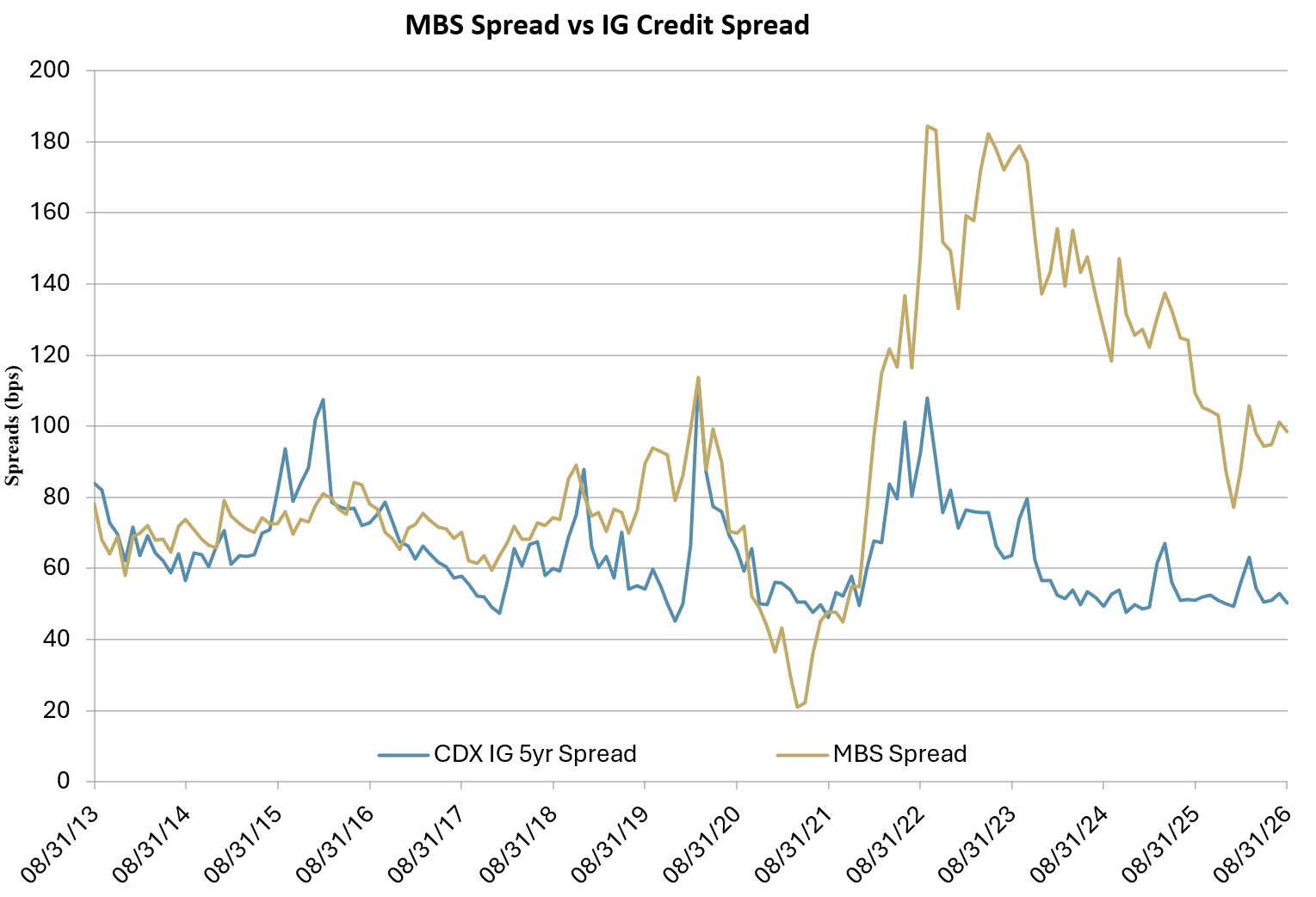
Agency MBS spreads are trading wider (higher yield) than their historical averages (see Figure 1). This gives Agency MBS higher yields than comparable Treasury securities with little credit risk. Also, consider that Investment Grade (IG) corporates are trading at historically tight levels, with the 5-year IG CDX Index currently trading around 50 basis points, after trading over 100 basis points in September 2022, suggesting limited upside at this point in the cycle.
Figure 1: MBS Spreads vs. Investment Grade (IG) Credit Spreads
Additionally, the FED has pivoted to a more hawkish stance as inflation concerns reignited after the supply shock from the surge in energy prices due to the continued conflict in the Middle East. This has kept the FED on hold this year after delivering 75 basis points in cuts to end 2025, thus keeping upward pressure on rates, with the 10-year Treasury and mortgage rates staying elevated.
Simplify MBS ETF (MTBA)
MTBA provides a straightforward approach to investing in Mortgage-Backed Securities (MBS) issued by Government-Sponsored Enterprises (GSEs) such as Ginnie Mae (GNMA), Fannie Mae (FNMA), and Freddie Mac (FHLMC) which have explicit and implicit backing from the U.S. government. The strategy combines an actively managed core portfolio consisting of predominantly MBS forward contracts (TBAs, or “To-Be-Announced”) and U.S. Government securities as collateral. Rather than tracking a benchmark (with legacy holdings at low coupons/longer durations), the ETF seeks to move beyond conventional constraints and seek the best positive absolute returns by investing in newer-issued, higher coupon MBS which have benefitted from rising rates.
As you can see from Figure 2, newly issued Agency MBS that are held in MTBA provide a higher yield and less duration than the traditional MBS index, as well as Corporate and Aggregate Bond indices.
Figure 2: Comparison of Fixed Income (as of 08/31/26)

The performance data quoted represents past performance and is no guarantee of future results. Current performance may be lower or higher than the performance data quoted. Investment returns and the principal value of an investment will fluctuate so that an investor's shares, when redeemed, may be worth more or less than their original cost. Performance data for the most recent month-end and standardized performance are available at simplify.us/etfs/mtba-simplify-mbs-etf The SEC 30-Day Yield for MTBA as of 7/31/26 is 3.80%.
The gross expense ratio for MTBA is 0.25%. The Fund’s adviser has contractually agreed, through at least October 31, 2026, to waive its management fees to 0.15% of the Fund’s average daily net assets. One cannot invest directly in an index.
Three Portfolio Use Cases for MTBA
- Investors seeking a higher income/lower duration substitute for MBS index funds
MTBA seeks to invest in agency MBS with coupons mostly in the 5.0% to 6.5% range, while the majority of MBS coupons in index funds typically are below 4%. The higher coupons in MTBA can result in not only higher current income, but higher yield to maturity as well. - As a complement to an existing core bond fund allocation to help reduce interest rate risk
Higher coupons have a secondary effect of a lower duration due to the elevated potential for prepayments. MTBA’s duration is considerably lower than MBS or core bond indices, giving it a lower sensitivity to changes in interest rates. - A defensive alternative to credit risk with potentially attractive yields
Agency MBS carry the implicit backing of the U.S. government and have similar credit ratings as U.S. Treasury securities. And despite having higher credit quality than investment-grade corporate bonds, they currently trade at wider spreads above comparable Treasuries.
In Conclusion
We view MBS, especially newly issued MBS, as attractive relative to many other asset classes right now in a challenging fixed income market. And with expectations that the FED either stays on hold or could potentially hike rates, this could keep mortgages rates elevated with continued issuance of higher coupons. We believe now looks like a great time to consider the simple yet powerful exposure to MBS that is executed inside MTBA, to help provide diversity in your fixed income allocation.
GLOSSARY
Agency Mortgage-Backed Securities (Agency MBS): Bonds backed by pools of home mortgages that are guaranteed or supported by government-sponsored entities such as Fannie Mae, Freddie Mac, or Ginnie Mae.
Basis Point (bp): A unit of measurement used for interest rates. One basis point equals 0.01% (100 basis points = 1.00%).
Bloomberg U.S. Aggregate Bond Index: A benchmark that tracks a broad range of high-quality U.S. bonds, including government, corporate, and mortgage-backed bonds.
Bloomberg U.S. Corporate Bond Index: A benchmark that tracks the performance of investment-grade corporate bonds issued by companies.
Bloomberg US Mortgage-Backed Securities (MBS) Index: A benchmark that tracks fixed-rate agency mortgage-backed pass-through securities guaranteed by Ginnie Mae (GNMA), Fannie Mae (FNMA), and Freddie Mac (FHLMC).
Coupon: The interest rate paid by a bond or mortgage-backed security. Higher coupon securities generally provide higher income payments.
Credit Risk: The risk that a borrower may fail to make interest or principal payments.
Duration: A measure of how sensitive a bond's price is to changes in interest rates. Lower duration generally means less sensitivity to rising or falling rates.
Investment Grade Bonds: Bonds issued by companies with relatively strong credit quality and a lower perceived risk of default.
Investment Grade (IG) Credit Spread: The extra yield that investment-grade corporate bonds pay compared with U.S. Treasury bonds of similar maturity.
Prepayment Risk: The risk that homeowners pay off or refinance their mortgages earlier than expected, affecting the cash flows received by investors.
SEC 30-Day Yield: The yield is calculated with a standardized formula and represents net investment income earned by a fund over a 30-day period, expressed as an annual percentage rate based on the fund's share price. The yield includes the effect of any fee waivers and/or reimbursements. Without waivers, yields would be reduced. This is also referred to as the "standardized yield", “30-Day Yield” and “Current Yield”. The unsubsidized SEC 30-Day Yield does not reflect the effect of any fee waivers and/or expense reimbursements.
Spread: The difference in yield between two investments, often used to compare the extra return offered for taking additional risk.
Treasury Securities: Debt securities issued by the U.S. government. They are generally considered among the safest fixed income investments.
To-Be-Announced (TBA) Market: A market for trading mortgage-backed securities before the specific underlying mortgages are identified. This is the primary way most Agency MBS are bought and sold.