

Share

Introduction
In today's dynamic market landscape, investors are constantly seeking strategies to grow their capital while mitigating risk. Traditional equity investments offer growth potential but often come with significant exposure to market downturns. This is where a hedged equity ETF can play a pivotal role, offering a sophisticated approach to capturing upside while providing a crucial layer of protection. In this article, we will define the hedged equity approach and subsequently highlight how Simplify's Hedged Equity ETF (HEQT) applies a hedged equity approach.
What is a Hedged Equity ETF?
At its core, a hedged equity ETF aims to provide exposure to the equity market with a built-in mechanism to help reduce downside risk. Unlike a standard equity ETF that simply tracks an index, a hedged equity ETF typically employs options strategies in an effort to create a protective barrier. This means that while you participate in the potential gains of the stock market, the impact of significant market corrections may be softened.
The Potential Benefits of a Hedged Equity Approach
Downside Protection: This is perhaps the most compelling benefit. By utilizing options, particularly put options, a hedged equity ETF can limit losses during market sell-offs. This can potentially provide investors with greater peace of mind and help preserve capital. Imagine a scenario where the broader market drops 10%; a well-constructed hedged equity strategy would potentially limit your loss to a smaller percentage and may even help provide positive returns.
Participating in Upside: The goal isn't just protection; it's also to capture a meaningful portion of the market's upside. Hedged equity strategies are designed to allow investors to benefit from market rallies, albeit often with a slightly moderated return compared to an unhedged equivalent during strong bull markets. This trade-off is often considered worthwhile for the added security.
Reduced Volatility: The hedging component naturally leads to lower overall portfolio volatility. For investors who are sensitive to large swings in their portfolio value, a hedged equity ETF seeks to offer a smoother investment journey, potentially making it easier to stick to their long-term investment plan.
Diversification of Risk Management: For many investors, simply diversifying across different asset classes isn't enough to fully address market risk. A hedged equity ETF offers a different dimension of risk management, focusing specifically on mitigating equity market downturns, which can be a valuable addition to a well-diversified portfolio.
Simplify Hedged Equity ETF (HEQT): A Closer Look
Simplify's Hedged Equity ETF (HEQT) is an example of how this strategy can be implemented. HEQT aims to provide investors with broad equity market exposure while simultaneously seeking to mitigate significant drawdowns. It achieves this through a transparent and rules-based options overlay strategy.
HEQT's approach involves:
- Long S&P 500 Exposure: Gaining exposure to the broad U.S. equity market through instruments like S&P 500 ETFs. Owning the underlying ETF helps to ensure we capture the dividend vs. gaining exposure synthetically.
- Options Overlay: We deploy a laddered options structure, a technique where put options on indices like the S&P 500 are purchased with staggered maturities (e.g., one-third expiring each month over a three-month horizon). This eliminates the cost and risk of rolling one large, concentrated position, instead creating a robust, dynamic hedge against market declines. This professional approach ensures that a portion of the portfolio is always preserved by rolling short-term options, providing continuous downside mitigation without sacrificing the flexibility needed to capture long-term growth.
- Targeting Defined Downside Protection: HEQT is designed with a clear objective to provide a significant buffer against large market sell-offs, aiming to reduce the impact of tail risk events.
Figure 1: Highlights of the investment approach for HEQT
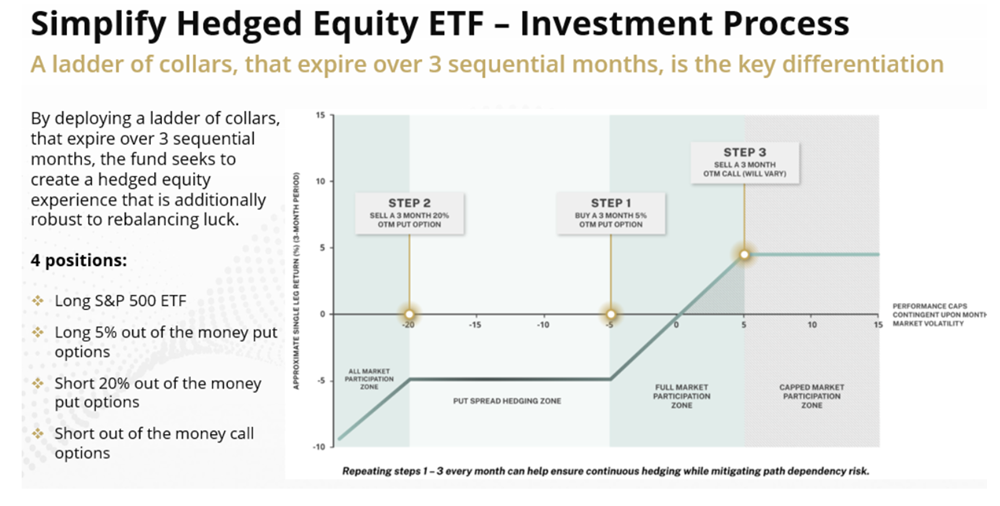
By combining broad equity exposure with a thoughtful and actively managed options strategy, HEQT endeavors to offer investors a compelling solution for navigating today's uncertain markets. It allows investors to stay invested in equities for long-term growth potential while maintaining a disciplined approach to managing risk.
Performance and Risk Profile
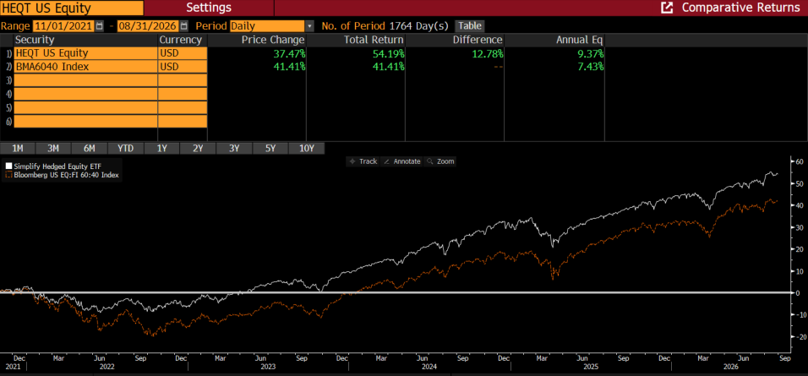
The performance data is compelling: Since its inception, HEQT has delivered a 9.0% annualized total return, representing an alpha generation of 205 basis points (bps) relative to the traditional 60/40 balanced portfolio. The since-inception performance metrics of HEQT are visually documented in Figure 2.
Figure 2: Since inception performance of HEQT vs 60/40 portfolio.
Why HEQT vs. the Largest Hedge Equity Peers?
The peer group comprises an equally weighted blend of the top 10 funds by assets under management ($43.4B AUM) within the Morningstar U.S. Fund Equity Hedged Category, selected from a broader universe of 181 funds and ETFs.
HEQT vs Top 10 Hedged Equity Funds (9/28/2023 to 8/31/2026)
| 23% higher Sortino ratio | 1.63 vs. 1.32 | |
| 20% lower expense ratio | 43 bps vs. 54 bps | |
| 10% lower max drawdown | 10.57 vs. 11.76 | |
| 7% lower annualized volatility | 8.03 vs. 8.65 |
Source: Morningstar, as of August 28, 2026. Past performance is no guarantee of future results.
Is a Hedged Equity ETF Right for You?
A hedged equity ETF like HEQT may be particularly attractive for:
- Risk-averse investors who want equity market participation but with less volatility.
- Investors nearing retirement who seek to protect their accumulated capital from significant market declines.
- Those looking to diversify their risk management strategies beyond traditional asset allocation.
- Investors seeking an equity solution that combines growth potential with proactive downside protection.
In Conclusion
While no investment can guarantee returns or eliminate risk entirely, hedged equity ETFs represent an innovative tool for investors looking to participate in the equity market with a greater degree of confidence. Simplify's HEQT offers a professionally managed and transparent way to implement such a strategy, potentially offering a more resilient path to achieving your long-term financial goals.
GLOSSARY
Alpha: The amount by which an investment outperforms (or underperforms) a benchmark after accounting for risk. In simple terms, alpha measures value added beyond what the market alone delivered.
Basis Point (bp): A unit used to describe small percentage changes. One basis point equals 0.01%. For example, 100 basis points equals 1.00%.
Bloomberg 60/40 Index: A benchmark that represents a traditional balanced portfolio made up of 60% stocks and 40% bonds.
Drawdown: The decline from an investment's highest value to its lowest value during a specific period. Maximum drawdown refers to the largest decline experienced.
Hedging: A risk-management technique designed to help reduce the impact of market declines. Hedging may help limit losses but cannot eliminate investment risk.
Options: Financial contracts that give the buyer the right, but not the obligation, to buy or sell an asset at a specified price before a certain date.
Put Option: A type of option that generally increases in value when the underlying market falls, making it a common tool for downside-risk management.
S&P 500 Index: An index that tracks 500 large U.S. companies and is commonly used as a measure of the U.S. stock market.
Sortino Ratio: A measure of risk-adjusted performance that evaluates returns relative to downside risk. A higher Sortino ratio generally indicates more return per unit of downside volatility.
Volatility: A measure of how much and how quickly prices move over a given span of time.